reaching toward the light

macro view of a frozen drop of water

cw: descriptions of sadness and depression

TOPICAL: this is part of The Cycle of the Seasons series


I think Saturdays tend to be writing days because I have the chance to breathe a bit and think the thoughts that clamored for my attention all week. I’m thoughtful to a fault; if I have not finished thinking a thought all the way through, I will not act on it. I used to believe that I was very quick-thinking, ready to jump from one thing to the next, but it turns out that I jumped because I was running from a Thing that was close enough to grab at my heels.

Trauma causes us to create new ways to behave, to keep ourselves safe, to keep the dark away.

The solstice approaches: Yule and the winter solstice for my northern hemisphere people, Litha and the summer solstice if you’re in the southern hemisphere. As a family, we observe Yule and Twelfth Night as our winter holidays. They’re more like markers, specific dates where we are building our family traditions year by year.

In my religious tradition, Yule is always December 21st and Twelfth Night is always January 2nd. During these twelve days, while the light begins to lengthen the days, minutes at a time, it is so easy to succumb to the darkness around us. It makes our limbs heavy and our hearts tender with sadness.

Grief is the flavor of deep winter and joy is the flame of hope.

So we have to look at joy the same way we look at hope; as a discipline. We cannot trust ourselves to unthinkingly reach for joy, so we must decide to do it. No matter how the reaching feels like artifice, we must do it. Our capacity for easier access to our own joy can only grow if we are willing to work at it a little at a time. A year at a time. A season at a time.

I can say this from personal experience: if I do not take inventory beforehand of what brings me joy and what brightens hope for me, I will not remember it during the deepest dark. As the sun seems to pause before coming back and warming us again, my thoughts often turn to what feels blue for me. I want to listen to music that amplifies my grief. I have a tendency to watch movies that horrify me or bring me to tears of hopelessness. It is so hard to find what will invite warmth back into the inside of my own self.

As a person who thinks about death and writes about death, it is hard to decide to dwell on other things. I have personal experience with what death feels like, what the underneath places sound like, and how crossing a threshold changes a person. Because I have a sense of what it feels like, it is easier for me to grasp with more nuance the things about grief and death and dying that I want to understand. And because I am a person who believes — however erroneous it might be — that I need to know what a thing feels like in order to orient toward it, this time of year is incredibly difficult to get through.

These are the hardest questions to answer: what brings me joy? What leads me toward hope?

The warmth of a cozy blanket when the air is cold. The softness of our toddler’s forehead when I smooth his hair out of his eyes for the umpteenth time. The belief that my family will be okay.

Music that makes my body want to dance.

Lights that dot the road and lead me forward.

The sureness that engaging in acts of hope increases the amount of hope around me. The belief that I am not alone. The experience of being needed.

Love without strings attached. Being seen for who I am and who I am not.

Every year the same thing.

As surely as the calendar plods along (even when the days get mixed up and blur together), the planet moves and the sun moves inside the moving universe and there are always times of plenty and times of barrenness.

It is correct that there are festival days that honor the fallow earth and our innate need to draw inward, and it is correct that there are festival days that honor the explosion of life and the enough-ness of harvest that brings enough to share. Every year the same thing. Every cycle repeats.

If we can believe that a harvest contributes to our reserves, we can believe that it will happen again, every time the wheel of the year turns to mark the season. And if we can believe there are times of enough-ness marked on the re-occuring wheel, we can believe that a time of fallow earth and early darkness will not last forever, because it too is part of the cycle.

The darkness never lasts. The light always returns. The light always remains, however small the flickering of your candle flame.

And here is a thing to add to your pile of hopefulness: we are not the same every year. There are things that happen each year that change us, and even though the cycle repeats unending, we are different every time. It is perhaps more of a spiral upward than a flat circle.

There is room for your grief. There is also room for your joy, and the act of reaching for your joy is an act of bravery.

In the darkness, reach toward the light, because the light will reach back.


As a post-script, here is a selection from a song that feels like warmth and comfort for me.

Ships will sink and castles they will fall

Wish that I could somehow fix it all

But I’ll be there, I’ll be there

Arms to keep you warm

Shelter from the storm

Cold hearts outside

Snow keeps falling

I hold you tight

No we’re not running

No we’re not running

I’ll surround you


Warmest Solstice blessings to you. May you walk in the Light.

feature image is a photo by Aaron Burden on Unsplash
I dream of disappointing my mother

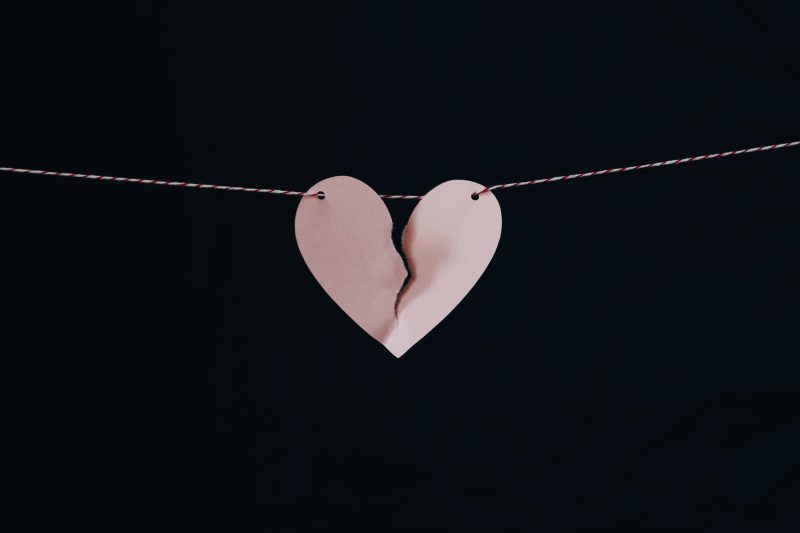
a pink paper heart ripped in the middle, hanging on a red and white striped wire against a black background

cw: family of origin, intimate partner abuse, queer identity, body pain

this is a piece I wrote for my deathworker publication; I’ve cross-posted it here


I should probably not be writing right now. I am trying not to squint at my dimmed screen as I type, because the haze of migraine pain gets worse if I squint.

I had a bad dream which was trying to be a good dream, but it was a bad dream because none of it is true.

A long time ago now, I grew up on a farm with a brother and a sister and a mom and a dad. My dad was abusive and scary, and when he drove off to work the four of us would relax a bit and exist in a different kind of day, a day where we disregarded his abusive and nonsensical rules, read books at the table while taking a very long time eating dinner, laughing absurdly at things we knew to be true about him but could never bring up in his presence. We made noises instead of creeping around the house in a cold fear.

Over time, my brother pulled away as he got older, and was a pretty reckless teenager. He set one of our fields on fire once and all he got was a stern lecture from dad. I still remember that. It was the first time I saw him spare his son the kind of punishments he would heap on his other two children. Whether or not this was the reason, my mom and sister and I bonded so closely that sometimes it was more like I had two sisters, not a sibling and a parent. For a while in my very early days of adulthood, we stopped being friends. My sister and I got on each other’s nerves and argued a lot. My mom was a frozen distant icicle of pain and anger while she slogged her way through the process of divorcing my dad. And I had no compassion for either of them, not until after my first husband left me and the only people I could trust were the two of them and probably my maternal grandparents.

Through relationships and new babies and raising kids and falling out of church (as if tumbling slowly down a long flight of stairs), somehow these two relationships remained with me. We had our disagreements and tread lightly around them, but mostly we made each other laugh and shared jokes that only people who had experienced intimate partner violence from the same person for more than a decade would understand. All the way up until my two oldest kids were teenagers, I still enjoyed talking and laughing with them about everything and nothing in particular.

But then, gender nonconformity in my children and Obergefell v. Hodges codifying same sex marriages as legal caused a catastrophic falling out with both of them, over the most ridiculous kind of thing: deadnaming 1deadnaming: to refer to or speak to someone by the name they were given at birth, if this differs from the name they go by presently. it is cruel and it is violent. and misgendering 2misgendering: to use pronouns (that may have been assigned at birth) when referring to or speaking to a person who does not use those pronouns any more. it is cruel and it is violent. my kids, along with being homophobic in general. I had changed my name recently as well, and both my mom and sister blithely ignored it and continued to call me by a name that is not mine. I absorbed this unkindness in myself, but the cruelty and lack of love and the will to learn about what my children were asking for was a toe over my line in the sand.

One of the last things I can remember saying to my mom was in an email explaining things I thought were already clear, and giving her an ultimatum — either respect my kids’ and my name choices and pronouns, or don’t talk to me until you will.

Some context, maybe.

When my Mamow’s 3no I don’t know why we spell it like that and yes my grandparents were born and grew up in west virginia. dementia got bad enough for Papow (see footnote 3) to hire a part-time aide to help him get some occasional space to rest or get some chores done, I started going out to their house once or twice a week to spend time with her and give him a bit of a break. I washed the dishes, I used their washer and dryer for my laundry, I sat with Mamow. I reminded her who the people in all the hanging photos were. I reminded her who I was, although when she thought I was her mother it made me oddly happy and I didn’t really want to explain that I wasn’t. I tried to tell her why her baby doll couldn’t actually eat the food she was trying so hard to spoon into its mouth. I washed her hair. I took her to get it dyed and cut, I got her favorite meal from McDonald’s, I made sure she took all the tablets she was supposed to take with her midday meal. One day she had an accident in the bathroom, and I cleaned her up. Taking care of her was a profound and holy experience for me.

Because of her failing health, and because once again capitalism failed her, my mom moved back home with her parents for a while. I took her to see her actively dying older sister in hospice, and watching her cry and touch her sister’s face gave me hope that she could let go of all the pain between them and just love her here at the end. I don’t know if she has. At my aunt’s funeral, just days after Christmas, I tried sharing a poem with her that I thought would be meaningful, but this was a mistake on my part — I should have asked first. She responded by angrily pushing me away with a catch in her throat, and walked off; something she rarely did. Grief is a wound that never heals, which sometimes opens again and bleeds as if it had just been inflicted. I did not understand how much she was hurting.

Some time after the funeral, I sent that email, and I never heard from her again. My sister texted me when my Mamow was in her last hours, and she died less than an hour after that text. I could never have gotten there on time. I was not invited to the funeral and I didn’t go. As of the writing of this piece, I have never visited her grave, even though I want to.

Anyway.

This is supposed to be about my mother. I guess it’s easy to talk about someone who has died, because there’s a finality and an ending to the trajectory of their mortal life. Someone who is still alive always has within them a possibility to change, to try again, even when it’s buried so far down it may as well not exist at all. Five years from now, maybe we’ll be friends again.

In my dream — I actually did have this dream last night after the migraine started — I was sat at a table with ten or so other people (although most of them had blurry faces and were just incidentally there for ambiance, I suppose) during what seemed to be some kind of family holiday. My mom was there and I could see her, across the table but not directly across from me. She knew I was there but did not speak to me. I was looking for the pages in her book that might be about me, and in my dream she had written pages and pages about me and expressed her sorrow that we were separated. I know this is not true because one of my partners read the book in order to tell me what was in it, if it seemed like I should know about it. Apparently, I, her eldest child, am barely mentioned, but in my dream she did talk about me and I had hope again that what we had could be rebuilt.

In my dream, I was crying and thinking through how to ask her if she would still love me. I couldn’t decide what to say; would you still love me if I was a boy? No, that’s binary for her sake, but wrong for me. Would you still love me if my gender has changed? Would you still love me if I am not a girl? I cried because I wanted it to be real that I could safely ask her and I wanted it to be real that she would say of course, and then love me in the way that I want my mother to love me.

Unfortunately (or perhaps fortunately, how do you end an impossible dream?), our three-year-old suddenly banged through my bedroom door and jumped on the bed, jumped back off the bed, and ran out of the room. And then he did it again, so I laid awake in a fog of migraine pain, worrying that he would do it more and that the volume of his response would hurt my head.

I cannot be the daughter you want, because I never was.

Mom, if you’re reading this, I guess this is an open letter to you. I do still love you. I am still connected to you by blood. I am still your oldest child, the one whose words you fear, the one that trusted you and supported you and would never leave unless you left me first. I wish you, as a person that changed her own name when I was thirteen because your birth name was just not what you wanted, could allow for other people to have changed their names as well, and to understand that a person can both be confused or sad about something and respond appropriately to a name change by using the new name. I wish you could understand why honoring our gender identities would mean so much to me, even if your grandkids don’t want to hear about it from you. I wish you could love me even though I my gender has changed, even though I am not a girl.

But I will continue to disappoint you, because I am unwilling to be other than who I am.


Are you queer or queer-adjacent? Do you need a death doula for yourself or someone you love? Are you trying to figure out your end of life plans and finding it really fucking difficult?

Subscription support to this publication means that I can offer my services either low-cost or free. Email me if you’d like to ask some questions: nixkelley@proton.me. I promise to be kind.


featured image is a photo by Kelly Sikkema on Unsplash

Footnotes

  • 1
    deadnaming: to refer to or speak to someone by the name they were given at birth, if this differs from the name they go by presently. it is cruel and it is violent.
  • 2
    misgendering: to use pronouns (that may have been assigned at birth) when referring to or speaking to a person who does not use those pronouns any more. it is cruel and it is violent.
  • 3
    no I don’t know why we spell it like that and yes my grandparents were born and grew up in west virginia.

what did I do this week?

a pile of monochrome question marks with WHAT spelled out on top of the pile

can anyone remember?


I read books:

I’ve got 24 books right now in my TBR/working-on pile 1Does not include all the other books that are waiting for me to read them; that number hasn’t been quantified because I don’t need that kind of stress in my life over an activity that I love. . Well, it’s not a pile any more, I made space in one and a half of my cube shelves to hold them. The problem with 24 books is not that there are 24 books. The problem is how do I choose which one to read first? Or next? I have tried over and over to prioritize them, but that was just shuffling them around and ultimately didn’t help whatsoever. I felt that I was playing favorites and hurting books’ feelings and my thought process got stuck there for a while.

It suddenly occurred to me that if I used some kind of random number generator, I could take away the pressure of choice and allow chaos to determine what book to read each day 2“Each day” means “each day that I am up for reading,” which is not necessarily every day. . I have a set of table-top RPG dice that I haven’t used for anything, so I took a D20 and a D4 and each reading day, I roll the D20 first to see what number comes up. If I roll a 20, I can either read the 20th book in the row or I can roll the D4 for a new number.

I have, in fact, read parts of five books this past week, including today. I feel SO ACCOMPLISHED.

The five books are:

  • Earthsea: The First Four Books, by Ursula K. Le Guin. I have read the first one, A Wizard of Earthsea, so I am currently working on the second one: The Tombs of Atuan. I can’t accurately describe what her writing means to me, other than saying that reading the texts she created is akin to reading religious scriptures. I treasure every moment I get with the words she wrote. [this book was number 10]
  • Sapiens, by Yuval Noah Harari. Back when he was teaching a very long online course at Coursera on this information, I drank it up and actually finished the course — unusual for my neurospicy self — and waited excitedly to buy this book when it came out. It’s a hefty text, so reading it a little at a time is a good idea. It’s not just history; it’s also philosophy, and picking apart why we think the way we do and what choices we’re making as a result. [this book was number 1]
  • trans like me, by c n lester. Oh, this book. I’ve had it for several years and it hasn’t aged badly at all. It is a bittersweet and freeing book that has made me feel a kinship and understanding with the author. I might put this back in the rotation once I finish it, so that I can read it again. [this book was number 19]
  • Ask: Building Consent Culture, an anthology edited by Kitty Stryker. This book is full of short essays by a diverse array of writers, including people of color and queer people. It is always heart-opening to read what’s been written by people like me. I already love this book. [this book was number 20]
  • The Art of Dying Well, by Katy Butler. Having ordered this entirely based on recommendations by fellow deathworkers, and on the basis of its title, I wasn’t prepared for who this book is actually for. It is written to people who will age and then die of old age in a capitalist society with shitty health care, where none of them have chronic illnesses. There are nuggets I can take from it, different perspectives that can inform my thought about how to do trans/non-binary/queer death care, so I will keep reading it. I had expected something aimed toward practitioners, but this book is written for people who want to have an active role in their aging, dying, and eventual death, which is definitely a good thing to engage in. [this book was number 6]

Of these five books, some were soul-nurturing, some were fascinatingly informative, and some will lead me into better praxis. I’m eagerly awaiting which book will roll up tomorrow and next week.

I contributed to:

I was interviewed for an article published by the Chicago Tribune, by a journalist who was conducting interviews and research in order to write a piece focusing on trans and nonbinary people, after a short piece of reporting she had done in which she mistakenly misgendered the person at the center of the piece.

You can read it at the Tribune’s website, and it’s quite good not just because I feel she accurately quoted me, but because I am not the only trans or non-binary person that contributed their knowledge to this piece: Deadnaming, misgendering and more: A trans and nonbinary community grapples with end-of-life complexities.

NOTE: the Chicago Tribune website appears to have chosen to paywall this piece even though it was not behind a paywall when I initially read it about a week ago. If you don’t subscribe but would like to read it, please leave me a comment saying so and I will figure out a workaround.

I wrote:

I’ve written before about my disillusionment with how queer culture exists in this country, specifically through the eyes of people who are not queer or even passingly familiar with what it’s like to be us. Transgender Day of Remembrance was yet another chance for the rest of society to pat themselves on the back if they remembered the day at all, and especially if they are content to ‘be aware’ of things but not do anything about them. I was angry. So I wrote about it.

I did some stuff:

I had a video call with my second youngest on Thanksgiving, because I couldn’t have my usual parenting time due to the motherfucking pandemic. It was a very nice video call and the toddler even showed up in my room during the call to say “hello” except instead of pronouncing the letter l’s, he used a y sound instead. It was very cute.

Last night we had ice cream sundaes for dinner and it was everything you might hope for on a Friday night indoors with family.

I barely turned my desktop computer on this week, and when I had time for playing a game, I turned on my Switch, which is hooked into my television via HDMI. I’ve been playing The Witcher IIIStardew Valley, and Mario Kart when the toddler is hanging out because he likes watching it.

I changed the sheets and blankets on my bed, which is always a sweaty endeavor and also very satisfying once it’s done. Peri-menopause is a fucking bitch.

After last week’s absolute dogshit experience of multiple migraines, this week I had a regular amount of pain. Hahahahahaha that is a ridiculous thing to say. Ahahaha. I’m not crying and I am allergic to onions.

the week isn’t done until I say so!

My calendar weeks start on Mondays, so technically, it is still this week until after I go to bed on Sunday night. This weekend I will have a toddler bedtime shift, a sous-chef shift (helping someone else prepare a meal, what even is this concept), and some laundry to run. On Sunday I will happily have a day off, then near the end of the night I will begin inventing things to be anxious about.

If you actually read this, thank you, because it matters to me that sometimes I am perceived when I would like to be perceived.

featured image is a photo by Vadim Bogulov on Unsplash

Footnotes

  • 1
    Does not include all the other books that are waiting for me to read them; that number hasn’t been quantified because I don’t need that kind of stress in my life over an activity that I love.
  • 2
    “Each day” means “each day that I am up for reading,” which is not necessarily every day.