cw: generational trauma, colonialism, abuse
Today I had an unexpected conversation with one of my biological kids about our shared ancestry. I have done some family tree research, partly to track down whether ‘I have an indigenous great-great-grandmother’ is bullshit or not [I don’t know either way because it was literally illegal to put anything other than WHITE on a birth certificate in the Virginias at that time], and it was an interesting conversation with my kid because the stories of my blood lineage are exactly that: stories.
Stories of immigration from war-torn countries, stories of being disowned by family in the name of forbidden love, stories of famous feuds, stories of a child whose father refused to claim him. Stories of grudges and lies and abuse. Stories of traveling gospel singers, of men carving fields from the hillsides, of superstitious mountain people walking barefoot down dusty roads. Stories of plastic-covered furniture and vacuuming oneself out of a room as if to erase even the memory of footprints. Stories of someone’s cousin that fell into an outhouse (I’m told he lived to smell better later). Stories of the woods that are safe and the woods that aren’t. Stories of racism and erasure and colonialism. Stories of watching indigenous people travel across the top of a nearby mountain, and ignorant people more afraid of them than the bears and copperheads surrounding them. Stories that are, some of them, impossible to prove either way, so they have become myth passed down through generations. Each of them trying to frame reality in a certain way, to make it mean what they want it to mean.
Did your ancestor die a white woman, while her lineage was later claimed by her descendants to be indigenous so that they could have more of what was stolen?
Did your French and Irish ancestors give a care about whose land they purchased and passed to their sons?
Did your mother’s mother’s mother die young because the Sight took her life too soon, or was it because she worked herself to death taking care of her children on an impoverished West Virginia mountainside above a holler 1A holler is what my ancestors of blood have called the hollow between the mountains, the low place where narrow strips of land can be farmed and where the crick flows. ?
Did your Prussian ancestors flee fascism or did they bring it with them?
How can I pick apart the threads of survival and resistance and fear and hate that my ancestors contributed to what has grown inside the story of this country like the roots of a tree breaking through stones? The people that have loved me have all been complicit, whether or not they realized how far out the web of their choices could go.
Back when I started digging into my ancestry about ten years ago, I spent dozens of hyper-focused hours looking further and further back, scrolling slowly across scans of handwritten documents from centuries past, looking at death certificates and draft cards and confusing census records. The further I went, the more my ancestors, with their names and stories, pressed in around me. I had to stop eventually because it literally became too difficult to breathe.
I think that the reason I love sad mountain music is that my blood vibrates with the memories of tiny coffins and backyard cemeteries and the cruelty of the darkness that resides in the hearts of those who are continually bereaved. I knew what a broken and bleeding heart felt like before the first time mine was broken.
I believe that some places feel like home to me because generations before me used to live there, and the land remembers. Whatever we’ve done, whomever we’ve killed or lied to or cheated to have what we have, the land remembers.
I believe that there are generational patterns, call them curses or history, that do not need to be repeated. I believe that the trauma inherent in every generation is passed to the next.
I may never have met most of my blood ancestors, but their stories are written into me all the same.
Functionally, I live in a chosen family because my queerness has made me distasteful to my biological family. If my family of origin had a family bible, my name would already have been crossed out of it along with the names of my children. But because I live in a chosen family, there is hope as well as fear now woven into my DNA. There is possibility and acceptance and love embedded into the experiences and stories my children can tell about themselves, and if they have children, to pass those things on to them.
I can’t unmake the history that’s told in my blood. But I can bend the arc of that history toward something better, something more hopeful, something that reckons with the harm that’s been done. So that one day, my descendants can rest in the shade of the trees I plant.
May the stories of those who deserved better be passed down in your own family line, so that future generations can be better people.
— Nix
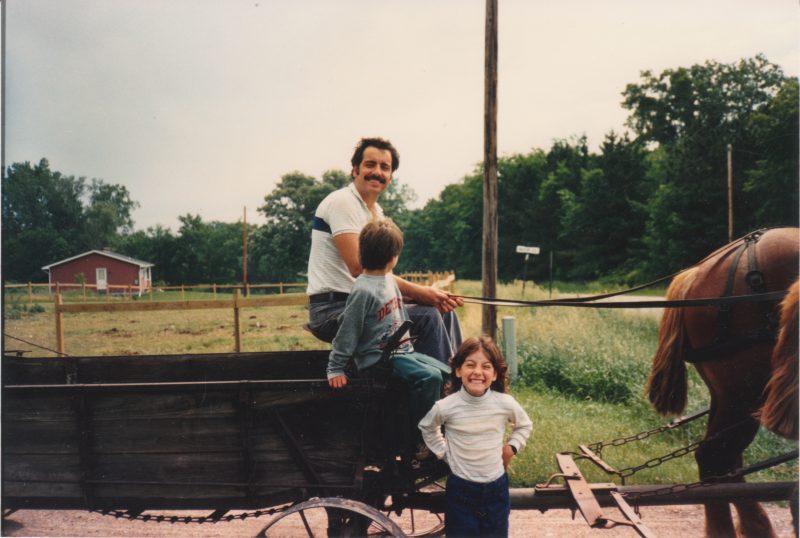
featured photo: my mom maybe took this photo? I don’t know. that’s my asshole dad, my little brother, and me, along with the backsides of two of our Belgian draught horses.
Footnotes
- 1A holler is what my ancestors of blood have called the hollow between the mountains, the low place where narrow strips of land can be farmed and where the crick flows.