Note: it is completely okay if you don’t agree with this statement. You don’t have to agree with me in the slightest, and if you’re reading this, I really appreciate it. The tiny head of a pin I’m balancing on as a deathworker and someone actively trying to decolonize myself puts me in a precarious situation; but we can’t just sit some things out. I have a voice to use here.
Queen Elizabeth II has died, and I wanted to make a statement, to the best of my ability as a deathworker and as a member of a mystery tradition that has many roots in Celtic lands and even specific protocols (that I cannot speak on) with regard to the British monarchy.
As a practitioner and a deathworker, I want to be as lawful neutral as possible here.
Everyone dies. All of us will experience the great mystery of death at some point in our existence. Being alive for ninety-six years does not mean death cannot come.
With every death as public as this one, there are those that mourn, those that rejoice, those that have confused and upsetting feelings and either do or don’t have the language to speak about those feelings.
No one is required to respect the dead, whether they died today or a thousand years ago.
When one of us dies, the world changes a little. How does it change? I cannot really say. Despite how much I would like to know the answer to that question, all I have is subjectivity.
When the leader of a country dies, they are judged by the actions they took, by the ones they did not take, by the ways in which they did or did not uphold the structure that they existed within.
I believe that we should all be free to speak about what that person means to us.
I also believe that with every death, there are those whose grief is immediate and sharp. Death rites and funerals are for the living and the left behind. They enshrine what we believe and hope is true.
We can miss someone deeply and hold them accountable in the same moment.
A brief personal story: when my paternal grandmother died recently, I felt an immense sense of relief. She had been overtly and passively abusive to me and my kids for decades. It was a relief to know she couldn’t do that to us any more.
When my maternal grandmother died, I had (and still have) a huge amount of grief and a feeling of deep loss. I was not able to be with her in her last hours, which I had hoped to do. My grief for her is wrapped up with my personal loss of time with her, and I can’t untangle that.
And yet, my maternal grandmother was a white woman that benefited from the patriarchy and she never did anything to address that. She was racist. She had a frightening capacity for hatred. It was nearly impossible to make her happy.
As her grandchild, I usually experienced the best of her. There are still some things she said that I will never be able to forget because of the meanness behind them, and there are many memories I have that I will always cherish because they meant love to me in that moment.
All that is to try and communicate that the dead are just as multifaceted as the living. The Queen’s legacy means something completely different to her blood family than to the thousands of people her monarchy conquered and kept for as long as possible.
There are people in my household today who are mourning, and my perspective is absolutely colored by that truth. In my very own small bubble, I am seeing the paradox of love and hatred contained in the mystery of death. My speech is tempered because of this.
I am, and will continue to be, a flawed person that is working to decolonize my thoughts, my belief system, my family, my legacy. I will fail and I hope to sometimes do the right thing.
On this day, I acknowledge the grief of many while acknowledging the celebration by others.
Such is the dichotomy that death presents to us, I suppose.
I hope for the dead Queen the same that I hope for every one of the dead: what she deserves. She is now among both the honored dead and the problematic ancestors. We must learn something true from those who pass.
What is remembered, lives.
And what is wrong, must be torn down and replaced with what our own problematic hopes can build.
featured image is the logo for Ever On And On, my death doula work
Did you know that I live in an intentional community? I live in an intentional community. One of us came up with that descriptor (I think it was me?), and it feels accurate.
We are a group of chosen family, some of us blood related, some of us not, some of us related legally, some of us not. We are all somewhere along the neurodivergent spectrum. Most of us identify as queer. Most of us are introverted as well, and need plenty of personal space and alone time. And we all need to know what to expect and when, although obviously some things are just unplanned.
communicating with words
One of the hardest things to manage when you live this way is the time and effort it takes to communicate with everyone. We have a great many themed chat groups in Keybase (it’s secure, which is why we use it), so it’s usually easy to decide where to put something we need to say, but that much communication can really use up the spoons.
The biggest reason that communication within our group takes so much effort, I think, is that we have a set of guidelines for how we communicate with each other, which includes an extra moment to think about what we’re going to say. In person, we get someone’s attention by starting off with ‘Excuse me, [name],’ and we try to be in visual range when we do so as much as possible. A lot of us have C-PTSD and are easily startled and occasionally hyper-vigilant. In a text chat, we only tag @here when it’s the right importance level (like ‘@here does anyone know where the extra toilet paper is?’ or ‘@here I lost my water bottle somewhere, please let me know if you see it’ or ‘@here if you heard a loud noise that was me dropping something, no need to panic’ or ‘@here dinner is ready!’), and we only tag specific people if we especially want their attention (for instance ‘@person lol’ accompanying a meme we’ve just shared that reminds us of them, or ‘@person and @other_person, do you know where the toddler’s favorite blanket is?’, or ‘@person could I run two loads of laundry tomorrow?’).
speaking of memes lol
One of my favorite things we do is ask for emoji reactions to something we just typed up, like if we are voting on what kind of dinner to have and ‘taco’ means tacos and ‘fries’ means McDonald’s. It’s much lower effort to respond with an emoji.
Private chats are important too, and operate much the same as group chats in terms of how we speak to each other, but of course they are different. Having them is important especially because it gives each person a way to say something that they don’t need or want everyone to engage with, whether it’s because it is sensitive content, or because they are having a problem with someone else and need help, or whatever other reason you’d want to share something privately.
communicating without words
We have other ways of communicating other than in-person and over text. For example, we have a toddler who has recently discovered how to open doors, although for the time being he only wants to open the doors he cares the most about — his door, the door to downstairs, and the door to the deck — so we leave the bathroom door shut. We have one of those cheap push-to-turn-on-or-off lights attached to the outside of the doors of both the second and first floor bathrooms, so that we can click on the light when we go into the bathroom, indicating this room is currently occupied, please do not come in, and click it off again when we leave, so whomever needs the bathroom next can figure out where to go (lol) without needing to guess or knock.
Oh, that’s another thing. We don’t knock on doors except VERY occasionally, because of the anxiety that a door knock can bring up. Did I mention that most of us have C-PTSD? I think the only person in the household that doesn’t have C-PTSD is the toddler. Personally, my door-knock anxiety is a result of the sheer number of police and CPS visits three years ago when I lived in a whole-ass other city, about my former second-eldest child: whether he had gotten into trouble, or was in the hospital, or had said something offhand to a mandatory reporter, which then had to be untangled because he has the ability to lie without even blinking. So in order to get someone’s attention or to ask to go into their space if their door is shut, you’d use the chat you have with that person and ask. Or, if the door is open, you would stand at the doorway and say ‘Excuse me [name], may I come in?’
A closed door, an open door, a light on the bathroom door — these are all pretty useful ways for us to communicate without words. Another thing that many of us tend to do is to use headphones or ear buds to manage sensory input and to have soothing background noise of some kind. Or we’re actively listening to music or a podcast or an audio book, or very occasionally, having a “phone conversation” like some kind of barbarian from 1990. Seeing someone wearing headphones or holding and interacting with a device or preparing a meal with the exhaust fan on is a signal that they may not hear you speaking, so you would default to texting them or carefully getting in their line of sight to get their attention non-verbally.
free to choose
The answer to any question at any time can be no. It’s false choice when there isn’t an option to say no. If the thing we’re talking about doesn’t have a yes/no option, we take a lot of time to explain why. We trust each other and are actively working on increasing our trust with each other by reaching agreement on things and by following the structures we’ve all agreed on.
We do our best to balance the needs of the many against the needs of the few (or the one) — thank you Leonard Nimoy and I miss you a lot — and this means that sometimes, saying no would be more harmful than saying yes. But we each have to make that choice for ourselves individually. This does mean that sometimes, one of us is spinning more plates than they can normally spin, and there’s an understanding that this means when the plate spinning is finished, that person is going to need some time to recover, whether it’s a few hours or a few days. And, again, that understanding exists because we’ve had conversations about it in different contexts and for various reasons. We try very hard not to make assumptions about what someone else already knows, which makes communication so valuable and necessary.
parallel play and infodumping
If you’ve been on the autism/ADHD/neurospicy side of TikTok or Twitter, or you ARE somewhere on that spectrum (which is entirely likely given that you’re reading this), you’ve probably heard something about the ways that people like us have different styles of personally relating with others.
Parallel play is one of the things we do when we all hang out together in the same room; we’re on our phones or maybe someone is streaming a show or playing a game or reading a book. We have a shared understanding that this kind of behavior does not mean that we don’t care and would rather not be present; it means that we are comfortable hanging out, and probably enjoying just being in the same room as the people we care about. There are many times that I want to be alone, but I don’t want to be by myself.
Another thing we tend to do is infodump about whatever thing we’ve been learning about or doing or noticing. But before the information is about to be dumped, we ask if the person or people would like to hear an astoundingly large amount of facts about that special interest. And, again, anyone is free to say no. I’m not always able to handle a firehose of information, but when I can, I love being able to be present when one of my loved ones is excitedly detailing all the things they know about their favorite video game (including who the game devs are and what the game creator is like including their life philosophy and how that shaped the story of the game, and/or what things are frustrating or problematic or amazing or enjoyable); or the type of book they are reading and which ones they love the most right now (including talking about where those books and authors seem to fall in terms of intersectionality and whether or not the queer person survives to the end of the story); or the current understanding of black holes or space-time or theories about the multiverse or how incredibly cool the images from the new James Webb telescope are.
even more stuff that I could talk about on this topic
It looks like I was right and this will be a series, because there are quite a few other things I want to share. Living this way is supportive and kind, and it is hard. I don’t want to pretend that having chosen family is superior to the experience of one’s family of origin, although for me personally that is true. And I don’t want to avoid the comments we’ve gotten occasionally about whether or not this is a cult. We aren’t a cult, and it’s not exactly possible to prove a negative, but I want to talk about who and what we are, and there’s a lot more than what I’ve covered here.
I hope you enjoyed this and are looking forward to the next time I write about it.
Oh! Feel free to ask me questions in the comments, because it would be really interesting to know what you are curious about.
today is my birthday and I am going to talk about myself
HELLO! I am uncomfortable when we are not about me, but also uncomfortable when we are about me, and this paradox at its zenith on my birthday. I love this day. I hate this day! I don’t care what I do today. I care SO MUCH about what I do today. I want to be made the center of the universe, and please do not notice me. Thank you.
since my last birthday
I have had a whole year to be forty-three, and I think it mostly went well. Forty-four is a weird number and I am looking at it with squinty suspicious eyes.
a constant experience of chronic illness
I’ve had fewer bad chronic illness flares. I didn’t go outside nearly as much as used to, partly because of the pandemic but primarily because I share custody of my thirteen-year-old differently that I did before. During this pandemic, I see her for summers, and until the daily death rate average is lower than it has been this entire time, I won’t be seeing her the rest of the year apart from some holiday time, because the quarantine time for a weekend visit would take up more time than a weekend anyway, which is unfair on all of us.
I remember when ‘chronic’ was sort of a ‘this is really cool’ word, but only in certain settings and always said with irony. No, wait, was it about drugs? I am not going to look it up.
As in all things, I have tried to understand and accept the ways my chronic illnesses — my disabilities — shape me, and how they give me clues about ways to approach daily life. I would like to think that I have come closer to acceptance this past year, and have had almost no instances of sadness-induced rage about the things I can and can’t do.
so how is that death doula thing going anyway
I have redone the business branding (as a recovering designer and online marketer, that phrase makes me feel icky) so that it looks and feels, to me, more inclusive and rainbow-y. So far my training has helped me to be with and experience the passing of two of our cats, and the experience of shutting the hell up while my teenagers tell me how absolutely heartbroken they are that a famous and beloved content creator died of cancer.
Whenever it’s Time To Get Started, I am guessing, a person outside my immediate chosen family will need and ask for my help. The best that I can do is to keep my metaphorical house in order so that I am as ready as I can be.
As an aside, death doesn’t usually happen on time and in an expected way, so it feels a little bizarre to try and predict potential scenarios. I’ve had my training, I know how to keep myself occupied in periods of quiet, I know how to reflectively listen, I know how to silently listen, I know how to find words of comfort, I know how to help someone plan for a thing — an upcoming death or really any kind of project, not that death is a project, but my point stands — and I know how to recognize my own urge to fix something so that I can keep from attempting a fix for someone without their need or consent. I’m as ready as I can be, which is to say, how can anyone be ready for death?
therapy is excruciating, thank you for asking
Some of my most effective emotional processing in the past year has been with my therapist. I have a tendency to try and talk myself out of therapy every goddamn time it’s therapy day: I don’t have anything bad happening, or I’m very upset and don’t want to talk about it, or I completely forget that when we aren’t working on what’s happening right now, we work on my complex PTSD and I know that the forgetting is, itself, a coping mechanism that is not helpful in that context.
In terrifying synchronicity, along with the reframing and gentle problem-solving and encouragement I’m receiving in therapy, I have been finding that my mind is almost constantly working out why people do or say the things they do or say, and I’m getting better at tracing the thread of that thing back into a mess of scribbly lines that represents what is likely their underlying trauma or experience. In other words, what brought you to this place? What happened to you? What coping mechanisms do you now have because of your experiences? What trauma has marked you like a tattoo, and what assumptions do you now carry invisibly with you because of that trauma?
Gaining the ability to understand people better in this kind of way is, like I said, terrifying, but also lovely. The better I understand or can surmise, the more helpful and effective my choices can be. And the older I get, the more I see how much trauma is part of everyone’s lived experience. I’ve been told that this kind of introspection and understanding means that I have actually been working on myself, so hooray for me, I guess? Eek.
so, um, politics
Imagine the phrase ‘the world is a trash fire’ sung to the opening lyric of Bullet with Butterfly Wings: ‘the world is a vampire,’ by The Smashing Pumpkins.
despite all my rage, I am still just a rat in a cage
As a trans, non-gender-conforming, queer pagan disabled middle-aged parent, living in a queer and affirming family, almost every single news story has an impact on my lived experience. Staying at home because of a pandemic has had a nice on-effect of keeping me (and us) out of the public eye, for the most part.
I have a conceal carry permit and a very beautiful pistol (she has a name, as all important things do) and based on my firing range practice, I am a very good shot. I do not want to have to EVER use this skill in a real life scenario. Not ever.
games and music — aka, what I am doing to improve my quality of life
I went through a pretty intense period of buying every steeply-discounted game that looked and/or sounded like I would like to play it at some point. The result is a very full Steam library and a very full Switch, but what if I suddenly feel like playing Bioshock? Or one of those indie games about death? What if the experience of having a collection of games gives me the same level of seratonin as playing one?
I have to say, the experience of owning The Witcher 2 is much nicer than the experience of trying to play it.
I am currently enjoying Death Stranding so much that I spent the approximately nine dollars to upgrade it to the director’s cut, and I started a new game with a higher difficulty level and I’m still enjoying the heck out of it.
A couple of months ago, I decided to start new music playlists each month, because I was curious about how long I generally enjoy a song before my ears are done listening to it. Without looking at any data whatsoever, I estimate that I love listening to most songs for approximately two and a half months, after which I never want to hear it again unless it comes up in a shuffle rotation at some point in the future and then I can feel nostalgic about it.
There are songs that outlast that time period, songs that are favorites that stick with me, but most of what I listen to is fairly new in the playlist. I think that is very interesting and even if my attempt at drawing a conclusion that I have no written data to support is completely wrong, I do find that it has helped me not to feel weirdly guilty about being done listening to a song. Also, with a new playlist each month, I don’t have to remove songs from playlists nearly as much when I am tired of them, and this pleases the traumatized part of me that makes me feel like an awful person for removing a song from a playlist.
what else?
I’ve nearly abandoned Facebook altogether, not the least because the newer updates to the user interface finally became too cluttered for my neurodivergent ass to want to look at.
Twitter, for all its faults, has become my new doomscrolling app. I enjoy how I can retweet or say whatever batshit thing happens to my timeline or in my brain.
[edit: Y I K E S]
I do also like the immediacy of the news cycle on Twitter; I get infodumps or at least inklings about important things just by scrolling through the app every day.
I have been writing here on Substack [edit: lol back to personal websites again instead], which I don’t want to call a newsletter because YUCK, and I am enjoying the opportunity to write in just one goddamn place for once. I’ve been paring back my internet presence(s), because it’s silly to spread myself so thin. I’m the only me there is, so expecting myself to do more than I can is absolutely ridiculous. (There, see? I wouldn’t have been able to think of it that way until recently. Therapy works!!)
some parting thoughts, if you will —
If you haven’t, or even if you have, please read the rice saga thread.
And That’s Why We Drink remains my favorite podcast, which is really saying something. I go through phases with podcasts the same as I do with most music.
I discovered that ASMR videos not only give me the electric brain tingles that are so relaxing for me, they work on the toddler too for helping him be sleepy enough to close his eyes. Here’s one of my favorites:
I used an illuminating and enjoyable writing prompt which asked the question, what did your deity feel like before they had a name? (I don’t actually think there is anything that does not have a name, because I believe that everything has a true name, but this was a gorgeous excuse for some short poetic bursts in honor of five specific deities.
(I’ve now deleted Twitter since this is me from the future right now, but I do still have those short poems in my archive somewhere. Maybe one day I will fish them out and put them somewhere else.)
I think that’s it, for now. I could go on and on but at that point, most of you will have forgot what the point of this was to begin with, and close the tab. Which is fair.
I am fond of writing for you. I hope that I get to keep doing it for more and more years.
xoxoxox, Nix
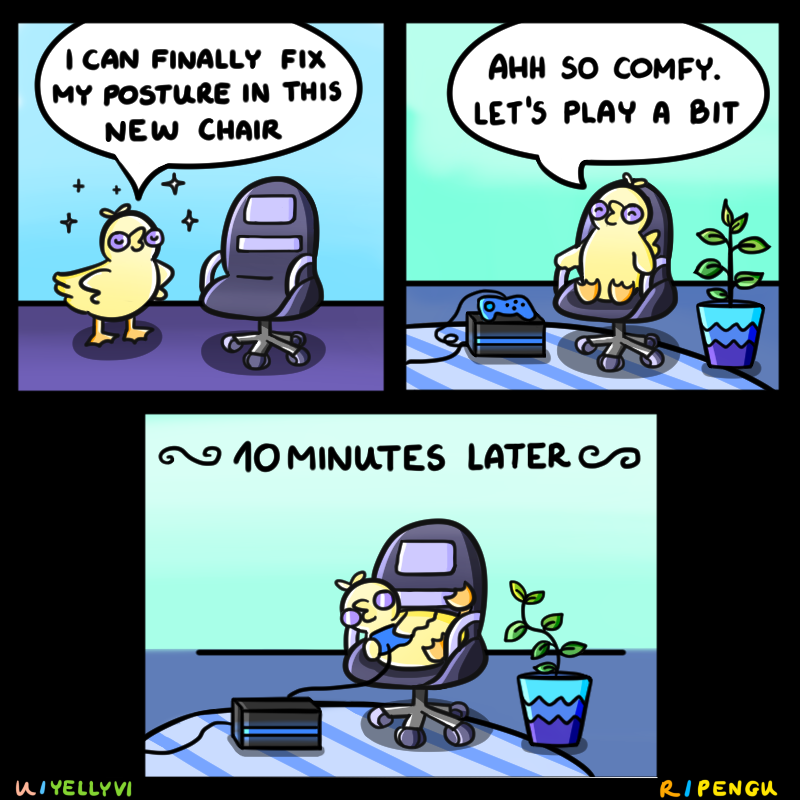
featured image is a webcomic posted by u/yellyvi on r/pengu