this is a cross-post; it was written by me at our household substack
I’m enjoying the newness on Mastodon, and its embedded consent culture that feels similar to how we handle our communication here at home. I don’t want to give the impression that we have it all figured out already and that we are the best ever at careful yet truthful conversation and communication, but I do think there are things I have learned from the experience of changing the culture in myself — decolonizing my own assumptions and beliefs — that are helping me enormously in seeing and appreciating the Mastodon approach to harm reduction.
To help me think my way through this subject, which is still complicated for me a lot of the time, I am going to use my experience here at home and a few examples of what seem to me are examples of doing the math of harm.
math of harm? what are you talking about?
The ‘math of harm’ is a phrase I’ve been using more often recently because it’s helping me properly frame how to think through how to make the best available decision, while acknowledging that there is no way to do NO harm, even with the best of intentions and the most information.
The math of harm, in my personal understanding, is the calculation required to determine how much an action or inaction will affect those around that choice. To gauge how far the ripples of consequence will likely go, and to find a place of balance that’s intentional.
One of the reasons it’s so easy to do harm, by words or choices or overt action, is that we generally don’t think through things nearly as much as we should. We tend to have go-to responses that we use without thinking, but not many of us have been able to dig into what’s underneath those default responses and why. It dredges up quite a lot of trauma, especially for people in the Western world; trauma from colonization, from unequal power structures, from institutional and structural harm. We don’t dig at it unless we notice it, and it’s not easy to see. Bringing into focus the reasons we made a subconscious choice or assumption is the work of a lifetime, but the more we know better, the better we can do.
center the most harmed in conversations about harm
Before I go any further, I want to acknowledge that I am a white person, coming from an exvangelical framework, living in a family structure that affords me the space to think about this and the privilege of having my needs met. I am not black, brown, indigenous, or otherwise marginalized except in my queerness. I can’t speak for people that aren’t me, and anything I write here should be reflective, not prescriptive. I have to do my own work to make sure that what I choose to write and share is coming from a place of having done the math of harm.
I want to add to the ways people like me can reflect and learn and do better, by talking about a subject that has informed my own personal growth and, hopefully, been a part of me becoming a better person. I am in therapy, and have used it to challenge my assumptions and internalized beliefs. I am also being taught in a tradition that requires each of us in it to do self-investigative work on a very regular basis. I may not be the best person to address this subject, but I have learned a lot and I hope that what I say here will add to what is helpful, and not, in my hubris, adding to harm.
a way of doing the math of harm
I don’t have a specific mathematical formula for doing this work. It might be better called the balance of harm. In order to engage in it, we have to gather as much information as we are able, and we have to use that information to question our impulse to do or say or choose or act in certain ways. Often, after thinking through something, I will realize that I don’t actually have enough information to make a wise decision, so I will not do or say or choose or act in the way I had wanted to.
The question at the heart of this work has been, for me, to think about who is most likely to be harmed by doing the thing. I need to look outward from there, to the web and the ripples of likely additional harm. I need to think about whose needs are most important, and once I make a choice, I need to own up to any consequences that arise from that choice. Doing the math of harm doesn’t mean that I get to disconnect myself from my choice once I’ve made it; doing the math of harm puts me in a position to notice what’s happening as a result of what I did. It puts me in a place where I will be more likely to be called out when what I’ve done was harmful. Willingly putting myself into this position is necessary, because it ties the possibility of harm to a recognition of my part in it.
my family as an example of working to do the math of harm
We have multiple Keybase chats and channels that we use as a family. One of the most important type of chat we have, I think, is our collection of CW channels.
There is one main CW channel, where everyone is part of the channel and can contribute to it or read messages. Our format is to put ‘cw: thing, other thing’ and then use periods or key returns to make visual space between the cw: subject and the message itself. This gives each of us the chance to opt into messages that we feel prepared to read. Most of the time, we are all able to read the messages, and I think that may be because we know there’s been consideration before the message was posted. Nobody in this CW channel responds except with an emoji to the CW message; in our family communication context, an emoji reaction signifies ‘I see this’ and ‘I care.’ This CW channel is the most often used, and it is a very good gauge of how we’re all collectively doing each day. Not only is it a way to say ‘I am not doing okay right now for x and y reason,’ it is a way of gaining information to help the rest of us do the math of harm.
We post health updates, emotional updates, mental health updates, trauma updates. If I wake up for the day and see three people have already messaged the CW channel with body aches and pains, I know that it will mean a temporary rebalancing of who is able to do what thing that day. A person with a migraine or on the verge of a panic attack is going to need help with doing the things they’ve agreed to do each day, and possibly will ask for one of those things to be covered completely by someone else. This is also part of the math of harm; if I say ‘I woke up with a migraine and a lot of brain fog,’ I may also ask for help with something I’m doing that day, like a childcare shift for our toddler, or meal preparation, or laundry. As the person who’s sending the message about how I’m not doing well and perhaps why, I am also conscious that I can ask for help. We are all doing some part of the math of harm no matter who we are in this type of situation.
There’s another CW channel, which is for discussing topics that might be difficult or traumatizing to see and/or participate in, and we have a spoken understanding that a person can check that channel when they feel fortified enough to do so. In this channel, we can respond and converse a bit with the subject matter. We’ve used this channel to talk about upsetting world events, for example.
There is another CW channel that is for fewer people; those of us in that CW channel use it for updates that don’t need to go to the wider family because of the upset and harm they may cause. Again, we are doing the math of harm when we choose to put something in this channel rather than one of the other ones.
To put it bluntly, you can’t do the math of harm if you don’t know yourself and accept that you are flawed, will make mistakes, and will need to work toward making it right with someone you’ve harmed.
{ INTERMISSION — IN WHICH I HAD MY THERAPY SESSION FOR THE WEEK }
to be blunt: this work is hard. it’s so hard that it can feel impossible.
Doing this kind of inner work so that we can accurately — to the best of our ability — calculate the harm of a statement, a choice, an action? It is HARD. I would be remiss in talking about this subject without acknowledging that this work is hard.
And yet, I think we all need to do it.
Many of the marginalized communities most susceptible to harm are already actively engaging in this kind of work. They have been harmed, and they do not want to further harm their friends and others in similar positions to theirs. They are more careful, more thoughtful. The fact that people who have been marginalized may be in a better position to instruct the rest of us on how not to behave in harmful ways is probably one of the most ironic situations I can think of.
If you have ever had to educate a person that’s supposed to be helping you — a therapist, a doctor, a social worker, law enforcement — you know how easy it is to just let the harm happen to you rather than take on the different, perhaps escalating, harm that educating or explaining will do to you. Understanding that communities who experience the most harm are also less likely to open up to someone outside their community who is trying to help? That’s hard. And embarrassing. And humbling. And when people like me (white, privileged people) and people similar but not the same as me (cis straight people) decide it’s time to help the ‘less fortunate,’ it can get ugly and harmful really quickly.
we do the math of harm because it’s a way forward, not because it’s easy
Most, or maybe all, of the people who might read this have already heard the invitation to do our work. Sometimes the invitation comes with a slammed door, and an un-invitation to anything else that has to do with that person. People that have been harmed deserve honesty and they deserve to have their boundaries respected.
In this country, the United States, our ancestors who came here built a society on the blood and labor of others. So much harm has been done, to generations of people who were enslaved, and their descendants; to indigenous people whose lands and children and languages were stolen and often destroyed. And we who hold some privilege have been soaked in harm as well. We believe that our worth is equal to the value of our work. We believe that there is a possibility to do no harm. We believe that being called out means the end of everything, and that there is no coming back from it, so we scream and struggle and avoid seeing the harm we cause or to admitting it, even in private.
Last night I was listening to a podcast episode from Exvangelical, featuring Rabbi Danya Ruttenberg talking about the first step in the process of addressing harm. (I am EXTREMELY looking forward to reading her new book On Repentance and Repair)
She said:
When I say repentance, the Hebrew word is teshuvah. It is not — probably a lot of y’all have, like, REPENT!! [sounds of being shouted at]— for us, teshuvah means return. It’s like, come back. Come back to who you’re supposed to be as a person. Come back to connection with the divine, come back to integrity, come back to wholeness, come back to where you’re supposed to be. It’s not somebody yelling at you, it’s an invitation to return to where you were supposed to be all along.
Rabbi Danya Ruttenberg
there are at least two conversations that I know of, discussing the use of content warning tags on Mastodon
I have seen discussion about journalists who don’t want to use CW tags because it may mean that people don’t read the links and news they are posting.
I have seen discussion about BIPOC people being explained to death by people outside their community about why those people think that content about racism they post should come with a CW tag.
I haven’t seen, but have been thinking about, whether there should be CW tags in front of content about the resistance in Iran.
My thoughts on these so far are: look for who is being harmed, and tip the balance toward those people.
News is often about what bad thing has happened, and even opinion pieces can be upsetting to see, and a content warning up front helps everyone choose to see something, rather than forcing the issue of muting, blocking, or outright banning a whole instance (specifically in the context of using Mastodon). This makes sense to me, and it aligns with my understanding of consent culture.
BIPOC people need to be able to talk about their experiences, not just because they deserve the space to do so, but because we haven’t stopped harming them in those ways. We need to see it so that we can’t forget about it, so that we can do our work. We need to re-acknowledge continually that we need to learn to do better, and that it’s going to hurt our feelings until we get to the place where we realize that the only part of it that was about us is the part of it that led us to the inner work we desperately need to be engaging in. I’m highlighting this especially because this is work that I’m still doing, and will need to keep doing, because my own contribution to the kyriarchy runs so deeply that I have to keep digging to even see it.
Revolutionaries in Iran need the world to see and acknowledge what is happening, and the only way to do that is to be face-to-face with footage, with written content, with the knowledge that there are people being tortured and dying in horrifying ways because they want human rights. Even though my usual personal understanding of harm would lead me to suggest content warnings so that this content can be opted into instead of opted out of, I think this is an exception.
Some things require us to witness them, because turning away is a greater harm than looking at what is happening.
This was longer than I expected. It turns out that I have more to say about this than I realized, and I would like to talk about it more in the future.
Thank you for being here.
xox, Nix
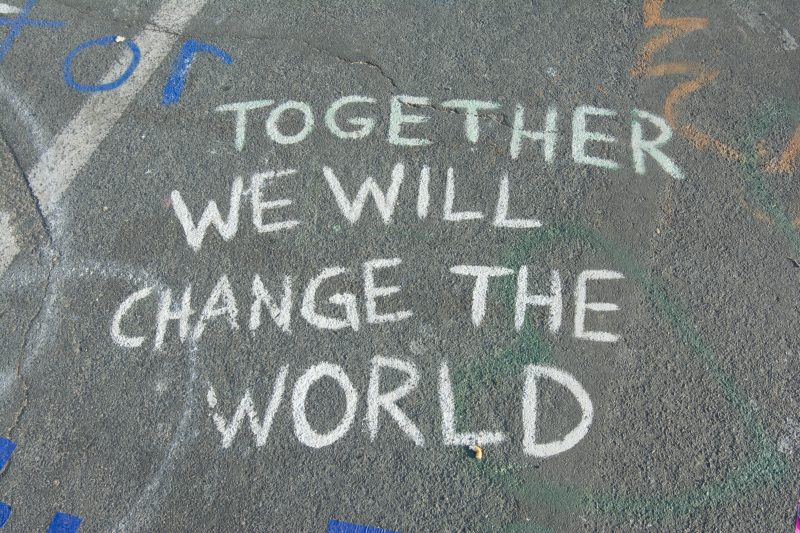
featured image is a photo by Priscilla Gyamfi on Unsplash