decolonizing death, part one of many

a dark path lined by trees, looking toward a break in the horizon bright with sunshine

cw: discussion of death, discussion of cultural harm


I had an epiphany today: I’ve been thinking and pondering for two years now on the concept of how to be of service to they dying and their loved ones. The risk to my personal health, as an immune-compromised individual, is too significant for me to be able to consider traveling yet; not to mention what I may unwittingly bring back into the place where I live, where many of us have chronic conditions that leave our immune systems susceptible.

The fact that right now, I can’t be physically present for someone as they are dying, is hard for me to accept. That I can’t hold a hand, or create a safe and sacred space in person. The distance inherent in this time of apocalypse and separation is a source of grief for me.

what if, instead of staying in my own grief, I could hold yours gently instead?

My epiphany was that I’ve been thinking about this from a direction that doesn’t make sense to what’s true right now. Rather than try to imagine what I can or can’t do, I could instead spend my time imagining how to help us help ourselves.

It’s a catastrophic example, but I think we’ve all heard stories of people without flight training being given instructions on how to land a plane safely, because there was no one else to do it. Maybe the future end of your life doesn’t feel like a plane about to crash, but the metaphor seems to work for now.

I have been doing a lot of internal work trying to understand how to decolonize my thinking and my frame of reference of myself and of the world I live in. I have been studying abolitionist ways of being, and I am incredibly blessed to be living in a house full of my chosen family, who are all learning better ways of being and choosing. And I think that my urge to be helpful, it stems from a sense of power imbalance in which I am the one holding the power-over.

We train and learn and become experienced so that we can be the best version of us that we can — not to engage in a fight with our shadow self or to punish and root out what we view as wrong, but to find the living truth within ourselves and bring it into the light so that it can grow to compassionately cover the ways we’ve been taught to harm ourselves and each other, like a climbing flowering plant that holds but doesn’t suffocate.

Now this is the law of the jungle —
as old and as true as the sky;
and the wolf that may keep it must prosper,
but the wolf that may break it must die.
As the creeper that girdles the tree trunk,
the law runneth forward and back —
for the strength of the pack is the wolf,
and the strength of the wolf is the pack.

Rudyard Kipling

It follows, I think, that in feeling cut off from what I expected to be doing, I have fallen into a habit of seeing things I think I need to fix or adjust, and trying to scoop up all the responsibility and necessity that would help me feel useful. But this is a harmful way of being. It is a harmful way of seeing, of choosing, of becoming.

I know things about grief and death and traversing the liminal pockets of space-time we enter when it is time to experience these things. This doesn’t mean that I need to ever be an authority on any of it, and it doesn’t mean that my knowledge or wisdom is necessary to anyone’s experience of dying. What it means is that I can be someone to hold that sacred space, to be there so you aren’t alone, to listen to what you need to say, to advocate for you.

It is not my job to save you. It is my Work to be the light for you if I can, when or where I’ve been invited. In remembering this, I’ve have arrived back at the place I was when I trained as a death doula.

I don’t want to support the kyriarchy in my efforts as a deathworker.

I don’t want to take money from people who need me.

I don’t want to take time and attention that many of us do not have.

I want to be aware of what kind of dangerous world we inhabit.

I want to be aware of what I can affect; and what is not mine to touch.

I need to be that which is needed, but no more, so that I don’t take up space that isn’t for me to occupy.

This is a thread of thought that I’ve had for quite a bit more than two years: how can I offer my Work to the world in way that will not reinforce the harm capitalism has caused us all? How can I expect anyone to see me trying to do that as anything but a trick to draw you in and then pounce on you for money once you’re psychologically dependent on me?

Judging by the dozens of asks and fundraisers and desperation that I see each week, most of us are not in a position to assume we can pay for something, especially if it’s end-of-life care, maybe because of the ways that dying has been commodified. It costs money to be sick, it costs money to die, it costs our loved ones money to honor us in death. Everything we desperately need seems to come with a price tag. Notarized wills and last wishes. Funerals. Coffins. Urns. An ambulance ride. A burial plot. Time away from work for laying our dead to rest. Emotional bandwidth we don’t have, to decide what to do with our loved one’s possessions. This all, directly or indirectly, costs us money, whether we have it or not.

What if, instead of money, the price could be connection and time? What if the price is to be vulnerable and to trust that we will not be harmed? The most precious things we have to give are our time, our love, our trust.

Our kyriarchic culture of scarcity, structural racism, punishment, shame — it has stomped its boots onto our broken hearts and left scars that may not ever heal.

There is still a lot here that hasn’t occurred to me yet. I’m very aware of how close to the beginning I still am of understanding concepts as big as abolition.

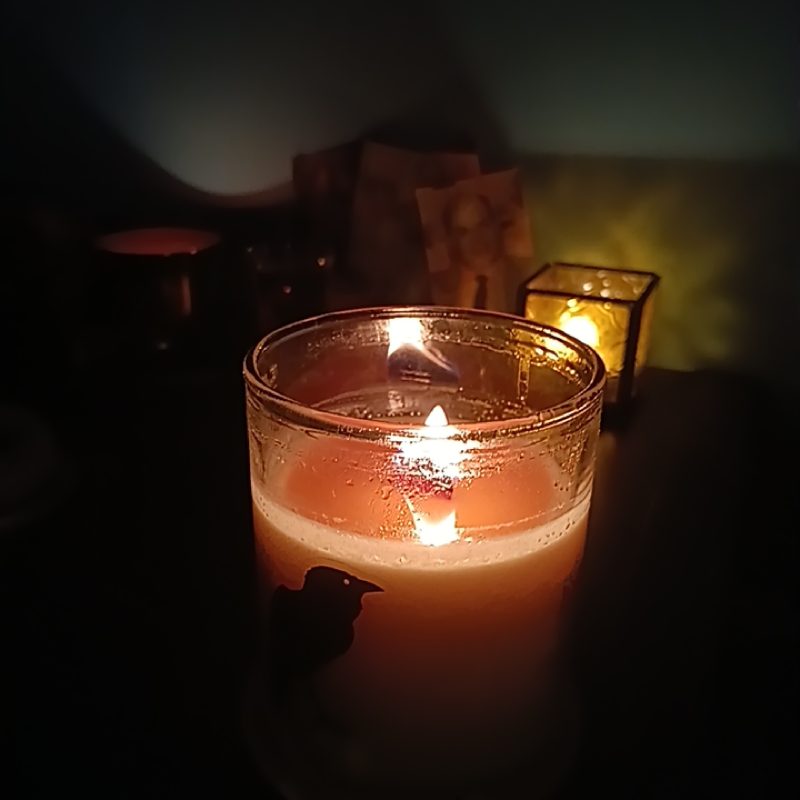
I am doing my best to find the most harmonious way to hold my candle in the darkness so that you can see it and find me, bringing your own light, so that we have more light together.

The only way to survive these many griefs is in community with each other.

Hold on
Let us take it slow
We need to stay strong
Right here
I’ll stay here and keep you warn
As you sing

Help me guide me through the night
Help me conquer all of my fright
Keep me sheltered from the storm
Play the song of warmth

from Song of Warmth, by Nekonomicon

You are loved, and you are not alone.

featured image is a photo by Marek Piwnicki on Unsplash

on #NCOD

a rainbow flag hangs from the metal balcony of a brick building

National Coming Out Day, in this economy?! cw: queer identity, death


I’m becoming more cynical the older I get.

I’ve written before on wanting to love Pride month and why that’s difficult for me — in short, Pride seems to have become a platform for allies to be louder than those of us in the LGBTQIA2S+ community. Pride has become less of a rallying cry for me, and more an epitaph, a month of remembrance. So many of us are gone who should still be here.

This might just mean that I’m not a Baby Queer 1I think a Baby Queer is someone that’s excited about being queer and doesn’t know that the floor is lava and the stove will burn you, and graduating from Baby Queer means you, unfortunately, know now that the floor is lava and have likely been burned by the stove. any more, or maybe it’s because I’m suspicious and mistrustful. In today’s world, with the cultural backlash against trans people specifically, it feels unsafe to be visibly queer.

It has always been unsafe to come out. I think that a lot of us that have come out did so because of a combination of the urgent life-affirming need to be our true self, and bravery in the face of both real and potential violence. For those of us who risk it, the price we pay for visibility is lower than the price of not being truly known, and so we string together little moments of hope into a rickety bridge over a chasm that’s so deep you can’t see all the bodies that are already down there.

I want to be done coming out, but I think I need to continue to do so, not just on this yearly National Coming Out Day, but every day. I think that coming out can be as small as pronouns in a Twitter bio, as big as being extremely gay in front of thousands of fans, or as quiet as being my favorite children’s book author Arnold Lobel when I was a child (and I still love his books; Frog and ToadOwl at Home, they are beautifully nostalgic for me). I think coming out is important when you’re able to do it, if only for the sake of other queer people so that they know who can be their chosen family when their families of origin give up and leave.

Despite my bio parents making sure they taught me that queerness was sinful and disgraceful, I never really believed it. Despite the crushes I have had / still have on many different genders of people over my life so far, I didn’t think that I was queer until six or seven years ago.

Coming out is a journey. Originally I came out as bisexual. Then I decided that pansexual was a better descriptor for me and I came out as pansexual. Then at some point I realized that I was gender non-conforming, and I refer to myself as genderqueer. Then alongside a low-dose testosterone regimen combined with an epiphany about my queerness, I realized that I’m part of the trans community and I have been this whole time. I’m not any binary of any kind; my gender is myself, which doesn’t — for me — need a word or phrase to describe it. It’s enough that I know that it’s my truth.

In the middle of evolving identities, I had many other coming-out moments; asking my chosen family to use new pronouns for me (and being abandoned by most of my blood family because of pronouns, which is honestly probably one of the most ridiculous reasons to pretend someone doesn’t exist for you any more); telling my kids about my new pronouns; choosing a new name that described to myself who I understand myself to be; telling my kids about my new name; navigating the constant experience of being misgendered and deadnamed 2A deadname is a person’s original legal name, usually given to them at birth, along with cultural assumptions about gender based on which genitals are present; it’s so gross and rude to use someone’s deadname when you know better, that most of us wouldn’t even deadname people we don’t get along with. Being misgendered is often the result of gender assumption based on how you look, or an assumption based on medical paperwork, or an act of disrespect. almost any time I need to interact with anyone that isn’t my chosen family, doctor, or therapist; cutting and shaving my hair into an extremely queer hairstyle; wearing clothes that could mark me as obviously queer to a stranger — my rainbow kilt, my flannel shirts, my suspenders, my sleeveless jacket (I had no idea how queer it would look when I first put it on). I dye my hair turquoise. I have a pretty big tattoo on my right arm. I have facial piercings and gauged ears. Even if I don’t look queer, at least I look weird.

Does any of this make sense?

I don’t want to keep coming out all the time, and sometimes I just avoid it by not interacting with people who don’t know me. Sometimes I avoid it because I’ve already used up my gender-advocate spoons for the day and I can’t manage another conversation that’s just me correcting someone about my pronouns or asking to be called by my name instead of what’s on my driver’s license.

Coming out is tiring and I wish that we lived in a world where it wasn’t necessary to be so specific about our identity in order not to be harmed in simple conversations.

But we don’t, so here it is: I am a genderqueer trans person with question marks where ‘romantic / sexual attraction’ goes, I haven’t finished changing my name legally yet because I’m terrified, I detest dating apps, and I’m queer. QUEER. Rainbow queer. Screamingly, frog-lovingly, flannel-owningly queer.

“For the Quest is achieved, and now all is over. I am glad you are here with me. Here at the end of all things, Sam.”

Frodo, as Mount Doom erupts around them, from Return of the King

Hi. I’m Nix. It’s nice to show up and meet you here.

featured image is a photo by Sand Crain on Unsplash

Footnotes

  • 1
    I think a Baby Queer is someone that’s excited about being queer and doesn’t know that the floor is lava and the stove will burn you, and graduating from Baby Queer means you, unfortunately, know now that the floor is lava and have likely been burned by the stove.
  • 2
    A deadname is a person’s original legal name, usually given to them at birth, along with cultural assumptions about gender based on which genitals are present; it’s so gross and rude to use someone’s deadname when you know better, that most of us wouldn’t even deadname people we don’t get along with. Being misgendered is often the result of gender assumption based on how you look, or an assumption based on medical paperwork, or an act of disrespect.

I could only lead you so far

a child reaching through a hole in a wall, stretching out an arm and making eye contact with the camera

cw: evangelicalism, kyriarchy

TOPICAL: this is part of the on being Exvangelical collection


Writing about the culture of evangelicalism that I was raised in and continued in for at least a decade of my adulthood is hard. It’s upsetting. I want to talk about it but it makes me both angry and depressed. All the good things I thought were there for me when I was young turned out to be gold dust on a moldy wall: get close enough and it’s going to make you sick.

it’s Sunday again

I hate using the phrase ‘fundamentalist evangelicalism’ over and over again, and yet I don’t know a better phrase to describe what my reality was for so many years.

I was raised by a narcissist and his victim/enabler, submerged into a paranoid ego-driven worldview. I was afraid of so many things. Recently, I told one of my partners that I had been worried from a young age that because I loved to sing and was pretty good at it, the Christian god would take it away from me at some point. In fact I still worry that if I love something too much, it will be snatched away in order to punish me for … loving it too much? The logic breaks down but the certainty of the feeling remains. My partner’s reaction was shock and sadness for that younger me, and at least I can hang onto that when I don’t know how to feel about my own old beliefs.

I’ve wanted to give a chronological account of my experience of fundamentalist evangelicalism and the journey that brought me out of it, but the sting of it is keeping me from being able to look back that far for long enough to write the words in that order. So instead I will write about my exvangelicalism from different perspectives and for different reasons, although the underlying theme will always be the Christian church and my exodus (ha) from it.

I helped strengthen the kyriarchy and it harmed me anyway

I can count on one hand the number of black people I knew growing up, and I might need two hands to count the brown people I knew. A common thing my paternal grandmother would say was that we had Cherokee blood, which I now know is likely false and informed by direct violence toward the indigenous people living on this land.

My evangelicalism was almost completely white, and one of the only helpful things my mother ever told me was that being a racist person was wrong. I’m not sure I fully understood why, but in spite of a lot of my other initial beliefs, I hung onto that one. Maybe it was a seed planted so I could grow into a better person later.

The painfulness of my childhood and the destruction of my self-worth in my young adulthood are so wrapped up with evangelicalism that I don’t think I can untangle them. This is the main reason that it’s so hard for me to talk about it; it hurts. I remember who I used to be, and I’m ashamed of having been that person and the for the things I used to say and believe and do. I’m ashamed that I used to believe that abortion was morally wrong and should be legislated to punish anyone who got one or helped someone get one. I’m ashamed that I disinvited and replaced my maid of honor in my wedding to my first husband, because she had gotten pregnant and wasn’t married. I’m ashamed that I used to be a youth pastor’s wife and participated in a broken system to reinforce those harmful structures in the kids we were supposed to be supporting and teaching and loving.

Right now as I type this, I’m not sure where this piece is going. I only know that I felt pulled to write something today; and last time I wrote about my exvangelical status, a lot of people read it, and my hope is that it’s been useful in someone else’s deconstruction and rebirth into a better way of being.

The songs I used to sing and play, for myself and often for a congregation in a church, still sound sweet to my ears, but it’s like a fond old memory of someone who’s killed someone. Maybe I shouldn’t miss it, but I do anyway.

There are two reasons that after I left fundamentalist evangelicalism behind, and pursued something else I didn’t know the shape of, I found Path of Light. Or rather, it found me.

the first reason

The inner layers of Path’s understanding of the world and its purpose reframed my old and painful beliefs, so that I could see that they were a faulty understanding, a cold and broken hallelujah, of something else more true. The things I loved and believed in earlier years weren’t completely wasted or completely false, and their flaws and mistakes seem clearer to me now, in a gentler light; I’m still angry about the ways I was lied to by my old faith, but it’s easier to give that gentleness and grace to myself now.

Seeds of truth are sprinkled into books, music, art, science, and all the ways we explain ourselves to ourselves. If I want to see proof of the things I believe now to be true, I can look all around me and find it.

the second reason

I desperately wanted something to help me grow, help me change, something to give me a discipline that I could use as an impetus toward whoever it is that I’m meant to be. I was, and still am, someone who wants to dig deep into theology and philosophy. Polytheistic belief structures and various experiences of both unverified personal gnosis and shared personal gnosis are just as important and fascinating to me as monotheistic theology used to be.

Rather than losing something, I gained new understanding, new reasons for discipline, new relationships with both deities and land spirits, and a new concept of ancestor veneration. There are my ancestors of blood — those whose DNA is part of my DNA; ancestors of spirit — the heroic dead, people whose lived experience informs my growing understanding of truth; and Path ancestors, who are a very particular kind of people. We draw from a deep well of not only exactness and pedantry, but also mercy and compassion.

the third reason

I didn’t know it yet, but there’s another reason that I found Path and it found me: I am here not just because I have faith in it, but also because it has faith in me.

The following song doesn’t have many lyrics, but it smacked an epiphany right into my face when I first heard it (I’ve taken some liberties with puncuation).

you were a wanderer, back when you were young

I remember your eyes were clear, brighter than the sun

with hands so soft, delicate and sweet

you learned to fall, and balance on your own two feet

I could only lead you so far — I believe in who you are

take the world by storm, muster all your strength

embrace the forces that surround you, bend gravity and space

you are a child of the stars, shout what has been unsung

open all the doors around you, use the power in your lungs

I could only lead you so far — I believe in who you are

Rule #9 – Child of the Stars, by Fish in a Birdcage

Do you know what it feels like to be believed in? Have you experienced the incredible fortune of knowing that you matter?

What evangelicalism taught me was that the thing itself was more important than anyone it crushed or killed along the way. Perfection meant destroying oneself, not to mention everyone else, in an attempt to stamp out anything that wasn’t holy enough.

What Path has taught me is that each of us are important, that nobody has to be any particular thing in order to be worthy of love and deserving of mercy and perhaps even second chances. I am learning that while we do our best to attain perfection, we also know that perfection is not possible, and so we hold a paradox of excellence and failure within ourselves.

I was raised to be a good Christian woman, not to question, not to learn except what was told to me, not to rebel against structures that harmed me and my children. Instead, I learned and tried and failed and, by the grace of the gods and ancestors, I have found the path that I can travel, and the people I belong with.

Also it turns out I’m queer and not a woman at all. Take that, past self, and know that you are worthy of love.

featured image is a photo by Edge2Edge Media on Unsplash