the center of the circle

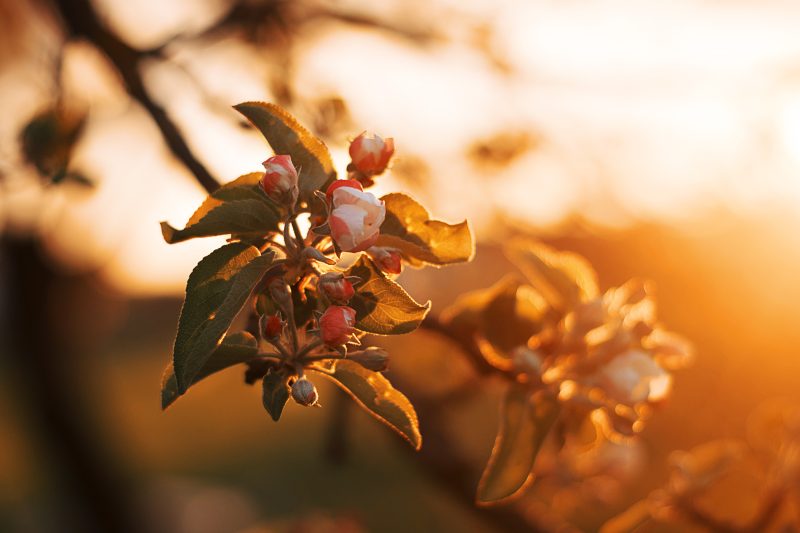
closeup of closed flower buds on a tree. the color is suffused with golden sunlight.

(originally published at leadmehome.substack.com; edited and reposted here)

cw: grief, death


There is plenty that has already been written and said about kvetching circles, also known as ‘Ring Theory.’ But just because it’s been said already, doesn’t mean it doesn’t need to be said again. This is for those in relationship with the person who is dying, or has already died.

You are here. You are the center of the circle.

Each person that’s grieving is the center of their own circle, and their feelings and experience of grieving are something that a grief counselor or therapist or priest or deathworker can help each person unwind for themselves. I’m not a therapist, although my time and heart are open for those who need someone to witness and hold a space for their grief and all the myriad ways that grief expresses itself.

But you? You are here. You are the center of the circle. The person in the middle of the innermost ring. You are closest to the person you’ve lost — or are losing. Grief doesn’t wait for someone to be gone, and you can be grieving someone well before they are gone. This is common.

The people around you, the ones who are your support, who can handle your tears and your grief and can be there without requiring any emotional labor from you; those are the people in the next circle out, the circle that encircles you.

Those people have their own people, or hopefully they do. They too need someone to listen, to comfort them, to be a landing place when they don’t know what they need.

And those people also, hopefully, have people that love them or at least have a vested interest in keeping them as whole and as happy as possible. Maybe in the circle around you, each of those people has a circle with a therapist or counselor in it. Maybe they have intimate partners, close friends, people that are willing to give their time and care in order to let them work through their own experience of grief.

But you? You are the center of the circle.

You have no obligation to comfort others. You have space to grieve as much or as little as you can, in each minute and in each day. You do not need to hold emotional space for anyone else; or if you do, it’s because you choose to.

Death can bring so many feelings up that may seem wrong at the time: relief, anger, exhaustion, or just numbness. You are the center of the circle.

So if you can, find those people who will be in the circle surrounding you, before you need them. They can be the support you need when it’s hardest and darkest.

Sometimes, especially when death is sudden and unexpected, the rings in the Ring Theory fall apart before they can stabilize. Everyone impacted by that death is going to feel their own particular feelings, and in dealing with those feelings, many of us put it away for later and use our finite energy to comfort others, to do something to feel less awful. Most people, especially if they have been socialized to caretake and nurture, will have the impulse to take on too much emotional labor when they are the center of the circle. Death is one of those mysteries that brings into focus what’s hardest for us, where our weak points are, which ways we are able to cope and which ways we aren’t.

Death is neither fair nor unfair; it is one of those things that just is. The realities of death’s consequences are the things that might be fair or unfair or cruel or impossible or incredibly difficult.

All of this is to say that it is okay for you to need more than you can give. To let grief thunder its way through you in the ways it needs to. To lean on others without thinking about how you can pay back the support later.

Just breathe, if you can. Just let yourself be loved. And if you are struggling alone, if there is nobody but you and there are no circles of support around you, please know that this is true: a paradox about us as people is that we can sometimes stick out our chins and do it alone, while inside we are torn up and in need of healing. My hope for you is that either you will find support, or it will find you.


I wrote this because I want to give you some little bit of comfort, some relieving way to frame your loss.

I wrote this because I am a deathworker and I can move as close to death as I need to, so that I can be part of your innermost circle. We who are inside the circle that surrounds you do not have to pick up your burdens and carry them, and we do not have to know exactly how you are feeling; what is ours to do is \give as much compassion and understanding as we are able, and sometimes take on logistical things on your behalf, so that your grief is easier for you to access and you can do — or not do — as much as you desire.

Most of all, though, I want you to be okay. You are the center of the circle. There is compassion for you, even if it’s only from the land and the sky and your ancestors.

xox
Nix

featured image is a photo by Irina Iriser on Unsplash
the promises we inherit

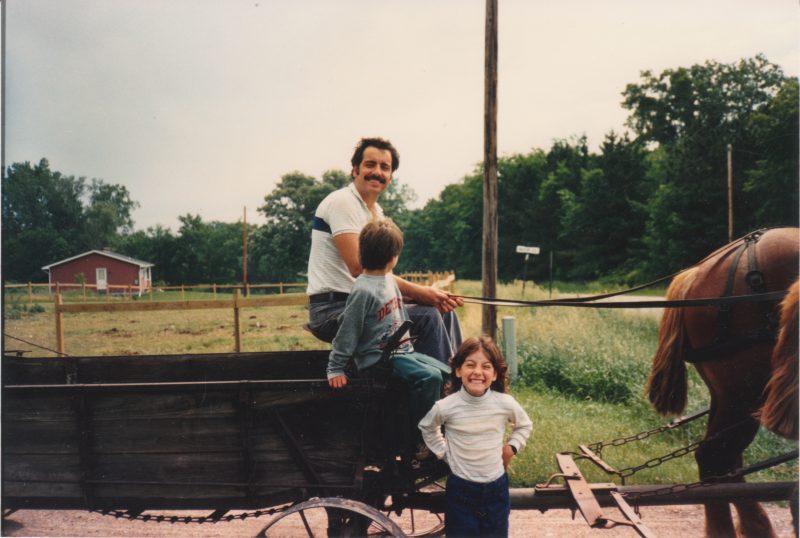
a dark-haired man with a mustache in a short sleeve white shirt is sitting on an old wooden manure spreader, holding the reins of a pair of auburn Belgian workhorses. a young child sits next to him turned away from the camera. another child faces the photographer with a big smile.

cw: generational trauma, colonialism, abuse


Today I had an unexpected conversation with one of my biological kids about our shared ancestry. I have done some family tree research, partly to track down whether ‘I have an indigenous great-great-grandmother’ is bullshit or not [I don’t know either way because it was literally illegal to put anything other than WHITE on a birth certificate in the Virginias at that time], and it was an interesting conversation with my kid because the stories of my blood lineage are exactly that: stories.

Stories of immigration from war-torn countries, stories of being disowned by family in the name of forbidden love, stories of famous feuds, stories of a child whose father refused to claim him. Stories of grudges and lies and abuse. Stories of traveling gospel singers, of men carving fields from the hillsides, of superstitious mountain people walking barefoot down dusty roads. Stories of plastic-covered furniture and vacuuming oneself out of a room as if to erase even the memory of footprints. Stories of someone’s cousin that fell into an outhouse (I’m told he lived to smell better later). Stories of the woods that are safe and the woods that aren’t. Stories of racism and erasure and colonialism. Stories of watching indigenous people travel across the top of a nearby mountain, and ignorant people more afraid of them than the bears and copperheads surrounding them. Stories that are, some of them, impossible to prove either way, so they have become myth passed down through generations. Each of them trying to frame reality in a certain way, to make it mean what they want it to mean.

Did your ancestor die a white woman, while her lineage was later claimed by her descendants to be indigenous so that they could have more of what was stolen?

Did your French and Irish ancestors give a care about whose land they purchased and passed to their sons?

Did your mother’s mother’s mother die young because the Sight took her life too soon, or was it because she worked herself to death taking care of her children on an impoverished West Virginia mountainside above a holler 1A holler is what my ancestors of blood have called the hollow between the mountains, the low place where narrow strips of land can be farmed and where the crick flows. ?

Did your Prussian ancestors flee fascism or did they bring it with them?

How can I pick apart the threads of survival and resistance and fear and hate that my ancestors contributed to what has grown inside the story of this country like the roots of a tree breaking through stones? The people that have loved me have all been complicit, whether or not they realized how far out the web of their choices could go.

Back when I started digging into my ancestry about ten years ago, I spent dozens of hyper-focused hours looking further and further back, scrolling slowly across scans of handwritten documents from centuries past, looking at death certificates and draft cards and confusing census records. The further I went, the more my ancestors, with their names and stories, pressed in around me. I had to stop eventually because it literally became too difficult to breathe.

I think that the reason I love sad mountain music is that my blood vibrates with the memories of tiny coffins and backyard cemeteries and the cruelty of the darkness that resides in the hearts of those who are continually bereaved. I knew what a broken and bleeding heart felt like before the first time mine was broken.

I believe that some places feel like home to me because generations before me used to live there, and the land remembers. Whatever we’ve done, whomever we’ve killed or lied to or cheated to have what we have, the land remembers.

I believe that there are generational patterns, call them curses or history, that do not need to be repeated. I believe that the trauma inherent in every generation is passed to the next.

I may never have met most of my blood ancestors, but their stories are written into me all the same.

‘Take Me Home’, performed by Lisbeth Scott & Nathan Barr

Functionally, I live in a chosen family because my queerness has made me distasteful to my biological family. If my family of origin had a family bible, my name would already have been crossed out of it along with the names of my children. But because I live in a chosen family, there is hope as well as fear now woven into my DNA. There is possibility and acceptance and love embedded into the experiences and stories my children can tell about themselves, and if they have children, to pass those things on to them.

I can’t unmake the history that’s told in my blood. But I can bend the arc of that history toward something better, something more hopeful, something that reckons with the harm that’s been done. So that one day, my descendants can rest in the shade of the trees I plant.

May the stories of those who deserved better be passed down in your own family line, so that future generations can be better people.

— Nix

featured photo: my mom maybe took this photo? I don’t know. that’s my asshole dad, my little brother, and me, along with the backsides of two of our Belgian draught horses.

Footnotes

  • 1
    A holler is what my ancestors of blood have called the hollow between the mountains, the low place where narrow strips of land can be farmed and where the crick flows.

how to lose a bunch of writing time

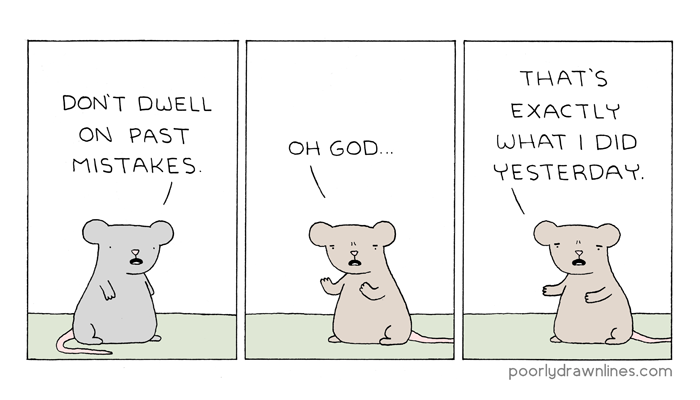
a comic in three panels. first panel is a mouse saying 'don't dwell on past mistakes.' second panel is a different mouse saying 'oh god...' third panel is the second mouse saying 'that's exactly what I did yesterday.'

cw: chronic illness experience


I’ve had a fair amount of time now with my chronic illness diagnoses 1so far: EDS (Ehlers Danlos Syndrome), MCAS (mast cell activation syndrome) and POTS (postural orthostatic tachycardia syndrome) — my doctor has been very good at pinpointing what’s going on with me and giving me diagnoses that are helpful, for which I am grateful.

I’ve had a chance to learn how to manage most of my symptoms, and the meds I have right now are as helpful as meds have been thus far. Unfortunately, even though I have better information and practice around taking care of myself (including asking for help taking care of myself before I become unable to ask for help) during most of my symptoms and symptom triggers, this doesn’t mean that I can have a regular kind of day every day. There are still swathes of time in which I have needed to rest because if I didn’t, I might end up in a medical emergency.

My experience through the thirteen days and the couple of weeks since then has been one of carefully spinning only as many plates as I could manage each day, plus a little extra effort where it was needed. I was near my limit but not over it. AND THEN. I had a day where one too many things happened and I had a POTS episode 2I have the rarer (so far) version of POTS where instead of just my blood pressure dropping and causing a fainting episode, first my blood pressure goes way up and I usually have a cardiac event plus the aftermath of wonky blood pressure. I lost several days to just trying to recover, and several days past that I was still not able to do as many things as usual. It is massively disheartening to know that my body’s needs will ensure they have top priority, by making me unavailable for things other than resting.

The correct meds to treat most of my symptoms are a collection of antihistamines, steroids, anti-inflammatories & NSAIDs, but the downside is that the meds themselves will cause me to need extra time to recover. If I’m having a POTS episode that turns into a cardiac issue, I will need a rescue antihistamine and a nebulizer with albuterol, both of which will keep my blood pressure up too high. There’s always a period of time after a POTS episode when I have a too-fast heart rate but no energy to even get up from lying down. I can breathe and am conscious BUT AT WHAT COST (hahahahaha cryfaceemoji.gif).

Plus, one of my biggest triggers for all my chronic illnesses is emotions and how I’m feeling them and how big they are, so I have had to learn not to panic — as much as it’s possible — when something scary starts happening to my body. The thing that pushed me over the edge into an episode was a big emotional thing that I didn’t have room to process, so all my spinning plates fell down and broke.

To recap, I apparently am not always superhuman, just sometimes.

Last week Wednesday, I had a POTS episode that was the most severe in a while (I used to have them often, back when I was first diagnosed) and it took me DOWN. One of the hardest things about it wasn’t processing my stuck emotional feelings, it was letting go of the possibility that I could still do everything and also recover. I had to ask for help. I had to stop for a while. I had to put it all down, and that is incredibly hard for me to do.

I’m still recovering, but I am doing much better than I was. This means: I can sit up without feeling like I’m going to fall over, I can use my computer without getting so worn out by the act of typing and mousing that I need a nap, and I can go up and down the stairs and do a few loads of laundry each evening. I can hang out with the toddler during my shifts and goof off with him. I can occasionally pick up something that someone else had to drop in order to take care of themself.

At the very least, having these chronic illnesses has put life itself into a new perspective. There’s nothing quite like how it feels to be able to do things after not being able to do things. It’s like that first swallow of cool water when you’ve been thirsty for hours: indescribably beautifully good.

I hope your days have been good and your nights have been restful.

— Nix

featured image is a webcomic by poorlydrawnlines, one of my favorite comic creators

Footnotes

  • 1
    so far: EDS (Ehlers Danlos Syndrome), MCAS (mast cell activation syndrome) and POTS (postural orthostatic tachycardia syndrome)
  • 2
    I have the rarer (so far) version of POTS where instead of just my blood pressure dropping and causing a fainting episode, first my blood pressure goes way up and I usually have a cardiac event plus the aftermath of wonky blood pressure